
Between barrel bombs and Facebook posts, my body is my battlefield
“Why do you have to always be on the side of those losing?” my mother asked me with a tone of soft blame as I started writing in support of those who used to be pro-regime after the fall of Bashar Al Assad, the Syrian dictator, in December 2024.
She continues with a higher pitch this time: “They have been advocating for you to be
killed, accusing you of being a terrorist and a Western agent for over a decade, and now
you are defending them!”
I realised at that moment how this group of people had shifted in my head from a threat into weaker individuals facing revenge and unjust violations on the day Assad fell. Hence, I automatically shifted to their side, while my mother couldn’t see them as
anything but losers.
My aunt, on the other hand, lashed out at me when I started writing about the sectarian massacres in the coastal area of Syria: “We finally have a chance to go back to Syria after 14 years of exile. Don’t burn our bridges again!”
Can I really stay silent and mind my own business? How?
Thirty years ago, in Khawla Bint Al-Zwar primary school in Edlib city in Northern Syria, the teacher was hitting those who didn’t do their homework with a wooden stick (mastara) on their hands.
A girl I didn’t like much was waiting in queue when I heard her whispering to her friend, “My dad hit me on this hand yesterday, I hope the teacher will hit the other one.”
I passed my notebook with the homework on to her and asked her to exchange places; that day I went back home with a swollen right hand and a full heart.
Suffering from violations of my own rights is the very reason I can’t see others going through the same without taking a stand, especially knowing how much worse it feels when you are alone.
The price, though, is very high, especially if you are a woman. Unlike my fellow male human rights defenders, I don’t get held accountable for my actions; it’s my family and sometimes even the men of my town who get attacked for not “raising me well”.
I don’t have a legacy of my own decisions and positions. No matter what I do, I will always be seen as a dependent. Unlike male journalists, I don’t get challenged for my ideas or for the pieces I write, they go directly to my body, my private life, my extended
family members, my looks and my lifestyle.
If I get kidnapped, my release won’t be celebrated the same way. I will be asked whether I endured sexual harassment rather than any other method of torture, because my sexualised reproductive body is what matters to my patriarchal community. Some
noble men might offer to marry me “to preserve my honour” as well. This happened with many women activists when they were released from the Assad regime prisons, like my friend Hanaa, who was 25 then with a Master’s Degree in Education.
Worse is to get executed by family members in an “honour killing” crime, as happened to two women from the Alwan family in an Aleppo suburb in April this year.
Because I am a woman with a stand, every move I make is heavily monitored: where I go, who I hang out with, who I add on Facebook, what words I use to describe an event, etc.
Everything is fuel for another rumour, for a disinformation and trolling campaign, which in our region could turn into a real-life offence very easily. The worst is the unsolicited misogyny, like what a secular comrade did to me in 2015, when I was still living in rebel-held Aleppo. He snapped a picture of me attending a women’s choir event in Turkey with my mother and aunts. I was wearing a casual skirt and t-shirt. Then he offered, in a public post on Facebook, to share it with whoever wanted to know the “woman activist who only wears a headscarf inside Syria.” This was despite him knowing that I had no option but to wear a headscarf in the rebel-held North to be able to stay and keep working.
I threw up when a friend shared the post with my picture in it. Why? He didn’t know me personally and we were both fighting for the same causes, including documenting the violations of ISIS, which had started kidnapping our friends at that point.
Sadly, this is not a unique incident. Despite living together under the regime’s barrel bombs and saving my life by preventing its forces from advancing in our areas, rebels who were fighting ISIS issued a death penalty against me for speaking up against the
killing of Charlie Hebdo journalists. And, because I am a woman, the ruling wasn’t only against me, but also against my male guardian, my previous partner.
Fear has turned into chronic stomach pain. I can feel the pain attack coming, even nine years later as I am writing about these incidents. The heartbeats speed up, the cold sweat gathers, and my stomach crunches like a crumpled paper in the bin.
“You are putting yourself in this misogynist space. Mind your own business and you’ll be fine,” I have been told repeatedly by loving friends, especially when seeing me getting attacked online.
Since popularity in our culture is a thermometer for how good you are, I am being judged as a bad person for being “hated by many”.
When binary narratives – good vs evil, thugs vs heroes – take over, applying a human rights approach and context to events and seeing reality through feminist lenses, make you a very easy target for all parties.
Against it all
I spent most of 2015 checking beneath my car for a grenade planted to kill me, and, even when in Turkey, I was looking behind me, suspecting a gun directed at my heart all the time.
The amount of thinking and planning needed just to go out to buy groceries or to complete any task is never taken into account in our workloads.
A couple of months after this, I received a call from the US consulate telling me that my US work visa was revoked because I live in rebel-held Syria. Then the worst happened when I was travelling to the UK in 2016 to attend an event about freedom of expression.
I was told at the UK border that the Syrian regime had reported my passport as stolen and that border control had to seize it because this was the law, despite knowing that this was just cross-national oppression by Assad to silence me.
That led me to apply for asylum in the UK, but the Interpol case against me stayed, and until now, nine years later, I am still dealing with its consequences, one of which is a travel ban I must deal with whenever I go back to Syria. The regime fell, but its
harassment goes on.
When everything goes against you, even the colonial lectures about dictatorship and freedom of the press, you reach a stage where you really doubt whether you are doing any good at all. That year, I felt trapped, lonely, and I questioned my values, activism,
journalism, and everything I stood for.
Despite leaving Syria, the online gaslighting campaigns against me continued on social media. And a report on national television called me a whore, jihadist, MI6, and spy all at once.
Online platforms, especially Facebook, weren’t responding to this violence and hate; threatening public posts were not removed no matter how many times we reported them, because Syria was not a “market” for them.
For example, a man living in Germany once posted a whole 10-minute video spreading fake news and hatred against me and my family for a piece I had written, and despite reporting it with many of my friends, it wasn’t removed from Facebook, though YouTube did remove it within 24 hours.
Four decades, not a single day of freedom
The campaigns to discredit me as a journalist and human rights defender, by those who would pick and choose which of my reporting suited them or didn’t, have hit me so badly that I stopped writing in Arabic for five years. I also stepped out of anything related to Syria for nine years professionally and mentally.
For most of my Western colleagues, stepping out of Syrian activism meant losing my worth, despite being a journalist with decades of experience. In colonial eyes, I am only an expert in narrating my own story. My experience is not taken seriously unless it’s related to my country and my personal life, unlike white human rights defenders who only need to read some books and do a visit to our region to be called “experts”.
Nine years of disappointment and betrayal were only bearable by working with women and queers from the SWANA region. I felt seen, like I mattered and my self-confidence was restored.
The American singer and civil rights activist Nina Simone once said, “Freedom is to me: no fear.” And at the age of 40, I think I have never been free, not even for a single day.
No matter how hard I try to give up on putting myself out there in public, I fail. In trying to locate the organ in my body that takes such “illogical” decisions to go on despite all this: the threats, isolation, burnout, betrayal and unpopularity, I fail.
Some say it’s conviction, love, or anger that keeps us going in defending human rights; I say it’s a spell that you can’t break no matter how much fear and horror you endure.
Giving up is a feature we delete when we walk the human rights-defending path. Here I am writing this piece from an old Damascene house, after finishing a training for women journalists. We spent most of it discussing our internal biases and how to produce impactful journalism that uplifts the most oppressed. We discussed the importance of holding power to account and building a feminist tribe we can belong to, to take refuge every time we get dispirited and attacked, to recharge and start all over again.
Until then, the most I hope for is to be free for one day and to experience the feeling of living without fear, before that angry armed man succeeds in proudly ending my life to “preserve his extreme values”.
I love my life very much, and perhaps the superpower I developed during our awful war is the ability to still stand up for even that man and for his family if they were ever under attack.
This piece is written for Unyielding: Personal Essays from Women Human Rights Defenders”.
Editor: Nadine Moawad
GenderIT Editor: Hija Kamran
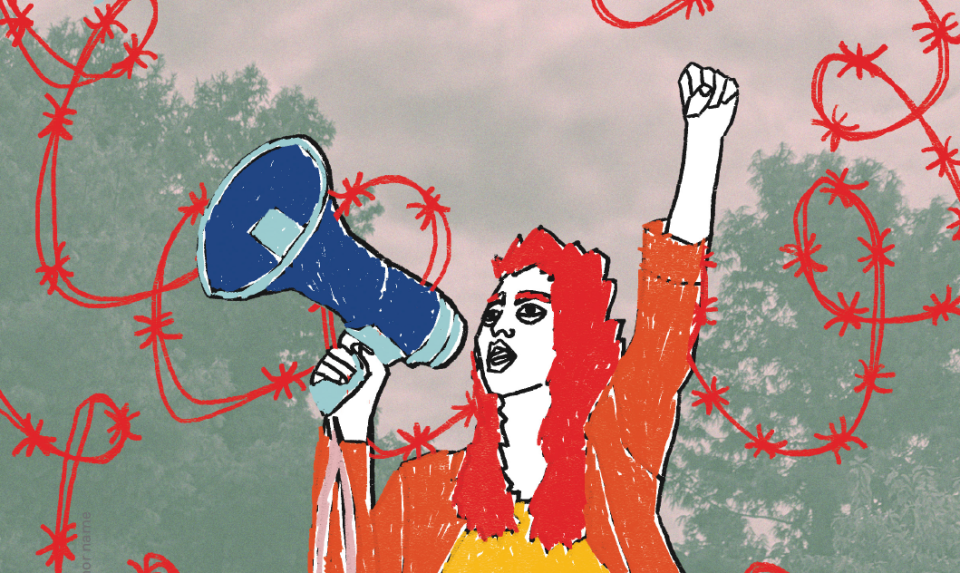
Illustrator: Rawand Issa
Layout: Cathy Chen
Proofreading and Copyediting: Lori Nordstrom